Women’s Leadership in the Defense of Democracy in Everyday Life
By sayra pinto
July 10, 2026

On July 30, Governor Angelina Aspuac will join us in Worcester, Massachusetts, for Women’s Leadership in the Defense of Democracy in Everyday Life, a gathering at Worcester State University focused on Maya political leadership, cultural continuity, democracy, and our shared responsibility for the future of the Americas.
Governor Aspuac is a Maya Kaqchikel political leader, weaver, organizer, and Governor of Sacatepéquez. She has spent decades defending the political authority, collective intellectual property, labor, and cultural continuity of Maya women through her leadership in the National Maya Weavers Movement (Movimiento Nacional de Tejedoras Ruchajixik ri qana’ojbäl), her roles in the Guatemalan government, and her service to her community of Santiago Sacatepéquez.
Her visit gives us an opportunity to gather around a story I believe everyone in the United States, and across our international community, should know: how Maya nations and ancestral authorities became the moral and organizational center of the movement that stopped an attempted coup d’état in Guatemala in 2023, only a few decades after the Guatemalan state committed genocide against Maya peoples.
Her visit is also part of a relationship already in motion. Our communities, now working together under the banner of For A Loving Future, have been building a bridge of relationship with the National Movement of Maya Weavers. We have been walking toward one another through sustained exchange, political accompaniment, shared learning, and a commitment to center life and build loving futures.
This gathering is one step across that bridge.
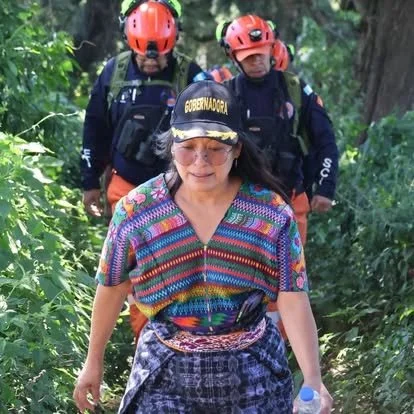
Governor Aspuac deploying her team during the earthquake crisis last summer. Facebook.From 1960 to 1996, Guatemala endured a thirty-six-year internal armed conflict. During its most violent period, particularly between 1981 and 1983, the Guatemalan state committed genocide against Maya peoples. More than 200,000 people were killed or forcibly disappeared. Of the victims identified by Guatemala’s Commission for Historical Clarification, 83 percent were Maya. Entire communities were massacred. Homes, crops, animals, ceremonial life, and the material conditions required for collective continuity were deliberately destroyed. An estimated 25,000 Maya children were adopted out of their communities.
The Peace Accords formally ended the conflict in 1996. Twenty-seven years later, in 2023, Guatemala faced an attempted coup d’état. Bernardo Arévalo had won the presidential election with nearly 60 percent of the vote, yet powerful actors within the Public Ministry and other state institutions moved to invalidate the election, criminalize the winning party, seize electoral materials, and prevent the peaceful transfer of power.
It was the Maya nations and ancestral authorities of Guatemala who provided the moral and organizational center of the national response. The 48 Cantons of Totonicapán and Indigenous authorities from Maya communities throughout the country called people into sustained, peaceful mobilization. They established an encampment outside the Public Ministry, organized actions throughout Guatemala, entered into negotiations with the government, and held the line for more than one hundred days. Xinka and Garífuna peoples, market workers, students, unions, neighborhood organizations, and many other sectors joined them.
Together, they defended the popular vote and helped ensure that the elected government could take office. They were defending more than a candidate or political party. They were defending the right of all Guatemalans to have their votes respected.
Consider the political maturity this required.
The peoples who stepped forward to protect Guatemala’s democracy were the descendants and survivors of communities the Guatemalan state had attempted to annihilate only a few decades earlier. They defended the democratic possibility of a society that continued to exclude them, dispossess them, criminalize their leadership, and benefit from the devastation their communities had endured.
Their actions came from a profound sense of political responsibility. They carried enough historical memory to recognize the threat, enough political discipline to organize across difference, and enough love for life to act for the good of the entire country.
And this story continues.
Through our direct relationships, we know that Maya communities are managing responses to the dangers they face. The same is true for our sisters in the National Maya Weavers Movement. We have seen Governor Aspuac subjected to political attacks, social media harassment, and death threats. We have learned not to treat efforts to demean her as politically neutral. They occur within a broader right-wing attack against Maya political authority and against leaders who insist upon the right of Maya peoples to govern, organize, and determine their own futures.
Even here in the United States, we have already had to defend Governor Aspuac’s dignity and authority. We have had to respond to efforts to diminish her, make her culturally legible while stripping away her politics, or treat her as a symbolic representative of Maya culture rather than as a Maya woman exercising political leadership under conditions of real danger.
We have therefore had to make clear political choices about how we receive and support her.
Imagine this happening in the United States. Imagine a right-wing government launching a coordinated campaign to annihilate Indigenous nations. Imagine entire communities being massacred, displaced, and stripped of the conditions necessary to carry their languages, cultures, governance, and collective lives forward.
Then imagine that approximately thirty years after that campaign formally ended, those same Indigenous nations organized a sustained national movement that saved constitutional democracy for everyone in the country.
Imagine that after they saved the country’s democracy, their authorities were incarcerated and prosecuted. Imagine that the same society continued to take their ceremonies, medicines, art, ecological knowledge, economic practices, and spiritual traditions, rename them as “American culture,” and make them available for consumption while denying the political authority of the peoples who created them.
What kind of political consciousness would be required for Indigenous nations to continue defending collective life under those conditions? What kind of relationship to the future would allow a people to defend the common good while carrying the truth of what had been done to them? What kind of political maturity allows people to distinguish between the state that harmed them, the society that benefited from that harm, and the generations whose futures nevertheless remain worth defending?
At the same time that this is happening in Guatemala, people here in the United States are gathering to make kites inspired by Maya traditions, often presenting them simply as expressions of “Guatemalan culture.”
The making of a kite carries the possibility of relationship. The harm appears when the cultural forms of a people are embraced while the conditions under which those people are struggling to remain alive, politically organized, and capable of governing themselves remain outside the frame.
The giant barriletes of Santiago Sacatepéquez and Sumpango emerge from living Maya communities, from particular relationships with the dead, the land, collective memory, artistic knowledge, and communal responsibility. Casting these practices simply as “Guatemalan culture” does more than blur their origins. It erases Maya peoples as the living political nations who created, govern, and carry them.
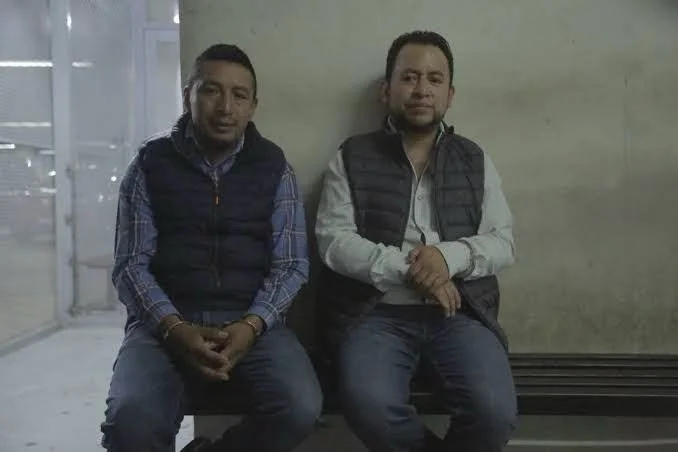
Hector Chaclán and Luis Pacheco. Photo from Prensa Comunitaria. Facebook.Maya authorities who helped defend Guatemala’s constitutional order are now incarcerated and prosecuted. Luis Pacheco and Héctor Chaclán, ancestral authorities of the 48 Cantons of Totonicapán, have remained in pretrial detention since April 2025. They face criminal charges arising from their leadership during the peaceful mobilizations of 2023. Amnesty International has designated them prisoners of conscience and called for their immediate and unconditional release.
Leocadio Juracán, a Maya Kaqchikel campesino leader, land defender, former member of Congress, and leader of the Comité Campesino del Altiplano, was detained in August 2025 in a case connected to his defense of Indigenous and campesino communities facing territorial dispossession. He was later released, but his case remains unresolved and the legal persecution continues.
The message is difficult to miss. Maya peoples became indispensable when the country’s democracy required defense. Once the immediate crisis passed, the institutions they helped preserve returned to treating Maya governance, territorial defense, political organization, and collective authority as threats.
Once weaving, kites, ceremonies, foods, medicinal knowledge, ecological knowledge, and communal ways of life are absorbed into the category of “Guatemalan,” the nation-state becomes their presumed owner. Maya peoples are reduced to cultural contributors within Guatemala rather than recognized as sovereign and self-determining peoples whose nations precede the state and whose knowledge remains inseparable from their territories, governance, and collective authority.
The category of “Guatemalan citizen” further complicates this erasure. Citizenship is often treated as culturally neutral, yet the position of the Guatemalan citizen frequently defaults to those who occupy the dominant Ladino national position, both in Guatemala and within the diaspora in the United States. Maya people then become visible as an ethnic or cultural minority inside Guatemalan identity rather than as members of distinct political nations. Their nationhood disappears beneath citizenship. Their governance becomes custom. Their political authority becomes culture. Their collective creations become national heritage available for others to claim.
This dynamic follows Maya peoples into the United States. Institutions and communities may believe they are honoring Guatemala while reproducing the same national framework that has denied Maya peoples recognition as peoples. A kite becomes Guatemalan. A textile becomes Guatemalan. A ceremony becomes Guatemalan. Meanwhile, the Maya nations from which these practices emerge remain unnamed, their authorities remain unrecognized, and their present political struggles remain outside the frame.
A similar dynamic appears across the fields of alternative medicine, midwifery, restorative and healing justice, and solidarity and restorative economies. Maya spiritual, medicinal, agricultural, cultural, and communal practices are taught, practiced, adapted, and advertised as Maya even when Maya practitioners, authorities, and communities are absent. Their origins may be acknowledged, yet the living peoples who carry the knowledge remain outside the leadership, compensation, ownership, and relationships through which it circulates.
Alternative medicine draws upon Maya plant knowledge, healing traditions, and spiritual practices while treating them as portable techniques. Midwifery spaces invoke Maya birth traditions while excluding Maya midwives and the community relationships through which their knowledge has been carried. Restorative and healing justice practitioners adopt ceremonies, circles, cosmologies, and relational practices while remaining disconnected from Maya practitioners and contemporary Maya political struggles. Solidarity and restorative economies celebrate Indigenous reciprocity, communal labor, and collective stewardship while failing to recognize the Maya nations whose economies, governance, and relationships have sustained those practices across generations.
Naming a practice as Maya does not, by itself, constitute respect. When knowledge is detached from Maya practitioners, territories, languages, lineages, governance, and systems of responsibility, attribution becomes another form of extraction. The Maya name provides cultural depth, political credibility, or spiritual legitimacy while Maya peoples remain excluded from authority and material benefit.
This is especially troubling in fields that claim to resist oppression, heal harm, restore relationships, and reconstitute more just forms of life.
The contradiction is profound. Maya knowledge is welcomed into alternative healing spaces while Maya practitioners remain absent. Maya birth traditions are admired while Maya midwives remain underrecognized and unsupported. Maya ceremonies and relational practices are used in restorative and healing justice spaces while Maya authorities are incarcerated and Maya political leaders are threatened. Maya forms of reciprocity and communal economy are invoked while Maya peoples remain excluded from control over their territories, creations, labor, and collective futures.
These practices emerge from particular peoples, lands, histories, cosmologies, relationships, and obligations. Their meaning remains connected to the authority of the people responsible for carrying them forward.
Culture cannot serve as a bridge when the people carrying it are treated as disposable. Cultural appreciation without political relationship reproduces the same structure of extraction: people take what is beautiful, spiritually resonant, economically useful, and publicly appealing while abandoning those whose collective lives created it. Maya culture becomes visible everywhere while Maya political existence is made increasingly precarious.
Our participation in this dynamic carries serious ethical consequences. This is especially true for those of us who are people of color and know what it means to be misnamed, politically flattened, and separated from the histories that make our lives intelligible. At minimum, our participation in the nationalization and extraction of Maya culture is a betrayal of relationship. At its most severe, it becomes an active contribution to the erasure of Maya peoples as sovereign and self-determining nations.
I want to believe we are better than this. Better than celebrating a people’s symbols while looking away from their persecution. Better than claiming their traditions as part of a shared culture while refusing responsibility for the people who carry them. Better than taking the weaving while rejecting the weaver, making the kite while ignoring the threatened community, or celebrating Maya beauty while Maya authorities sit in prison.
Perhaps the kites can become something else. Perhaps they can become an opening into responsibility.
Those who are moved by the beauty of Maya cultural traditions can also learn the names of incarcerated authorities. They can understand why communities are managing danger. They can refuse political and social media attacks against Indigenous leaders. They can recognize Governor Aspuac and other Maya leaders as political authorities rather than cultural representatives alone. They can enter into relationship with Maya peoples as living political nations whose governance, collective rights, and futures matter.
Governor Aspuac’s visit creates an opportunity to enter more deeply into this history and into the responsibilities it places before us. Her work emerges from the Maya political traditions and movements that have made this extraordinary defense of life and democracy possible.
Her work with the National Maya Weavers Movement insists that Maya culture cannot be detached from Maya peoples and converted into raw material for the Guatemalan nation, progressive social fields, or the global marketplace. Weaving is not decoration added to Guatemala’s national identity. It carries knowledge, history, territorial memory, collective authorship, women’s labor, governance, and a living means through which Maya peoples carry themselves forward.
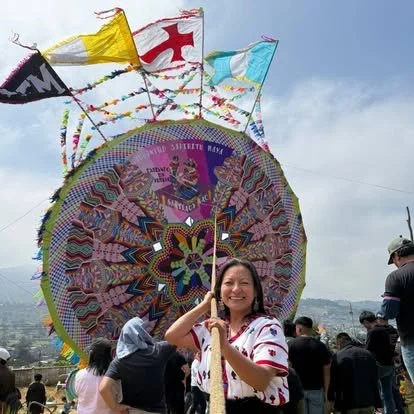
Governor Aspuac with a barrilete last year. Facebook.The country cannot take the weaving while rejecting the weaver. It cannot celebrate Maya knowledge while incarcerating Maya authorities. It cannot claim Maya ways as symbols of Guatemala while continuing to deny Maya peoples the right to exist and govern as peoples.
Governor Aspuac is not coming to Worcester as an ornament of multiculturalism or as a representative of an abstract “Guatemalan culture.” She is coming as a Maya Kaqchikel political leader and a defender of Maya women’s collective authority.
Receiving her responsibly means recognizing the risks she carries, protecting the integrity of her presence, and refusing to participate, through silence, simplification, or cultural consumption, in efforts to diminish her. Our support is neither ceremonial nor uncritical. It is a deliberate act of relationship and political responsibility.
I believe it is critical that exchanges of knowledge and practice occur within relationships of reciprocity that strengthen the peoples and movements from which that knowledge emerges.
Reciprocity means more than acknowledgment, attribution, or compensation for an individual practitioner. It means ensuring that the circulation of Maya knowledge strengthens Maya collective authority, political organization, cultural continuity, and the movements carrying that knowledge into the future. It asks those of us who learn from Maya practices to become responsible for the conditions under which Maya peoples can continue creating, governing, protecting, and transmitting them.
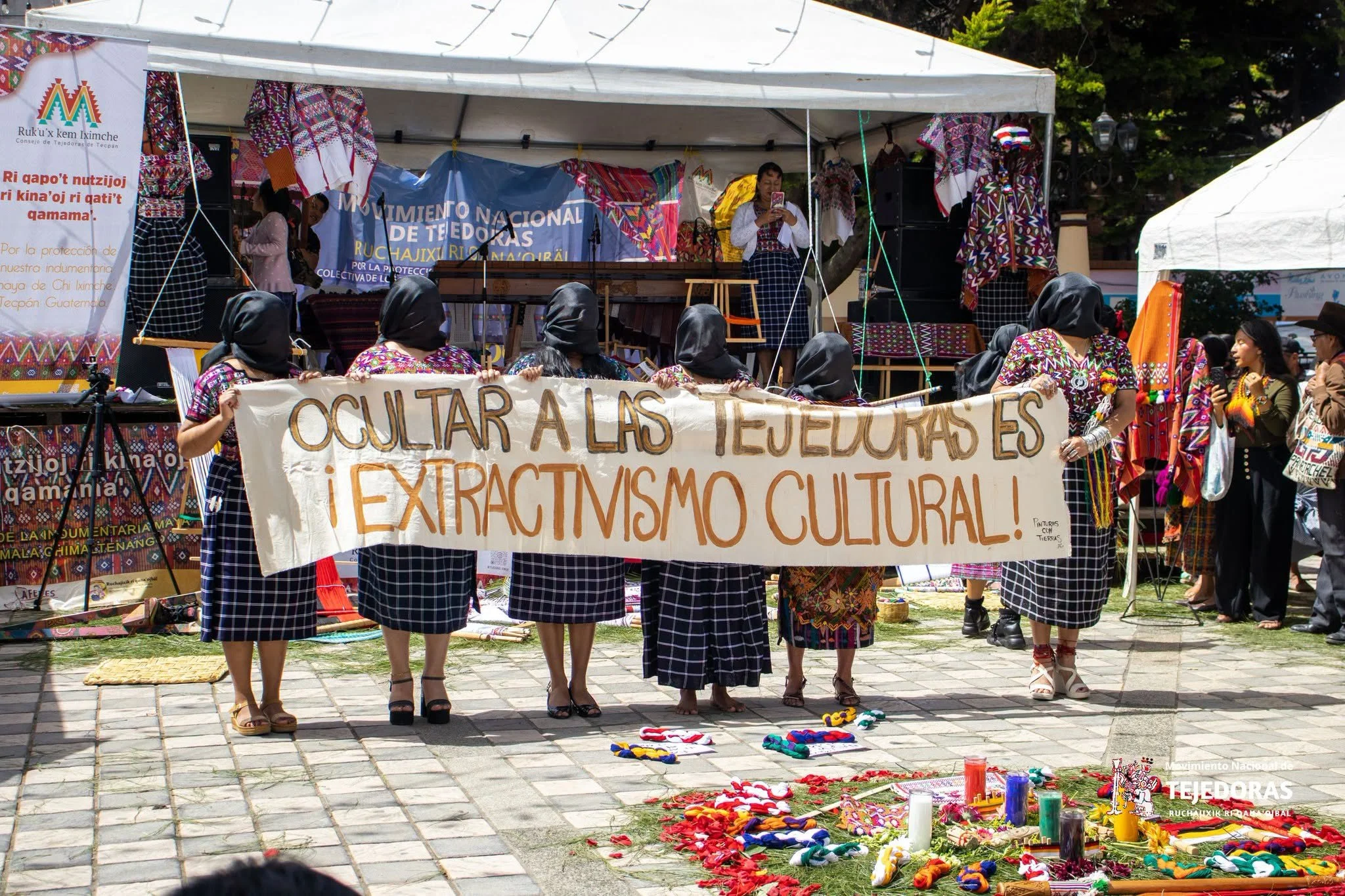
A Movement action on June 29th, 2026. Movimiento Nacional de Tejedoras Ruchajixik ri qana’ojbäl Facebook.This is why our relationship with the National Movement of Maya Weavers matters so deeply.
Through its defense of weaving as collective intellectual property, women’s labor, political knowledge, territorial memory, and living Maya inheritance, the Movement has played a singular role in producing a profound and, we hope, lasting cultural transformation. It has changed how weaving is understood, expanded the recognition of Maya women as political and intellectual authorities, and exposed the colonial arrangement through which Guatemala claims Maya culture while denying Maya peoples control over their creations and collective lives.
The Movement shines a path toward a future Guatemala capable of transcending the ills of a democracy born from colonialism, shaped through the modern nation-state, and limited by Enlightenment assumptions that promised universal freedom while preserving racial, territorial, and epistemic hierarchies. That democratic structure is proving increasingly unable to navigate the complexities of today or create the conditions required for a livable future.
The National Maya Weavers Movement offers another political horizon. Its work joins culture to governance, beauty to authority, knowledge to responsibility, and continuity to collective self-determination. It demonstrates how a people can protect what has been inherited while creating new political possibilities for generations still to come.
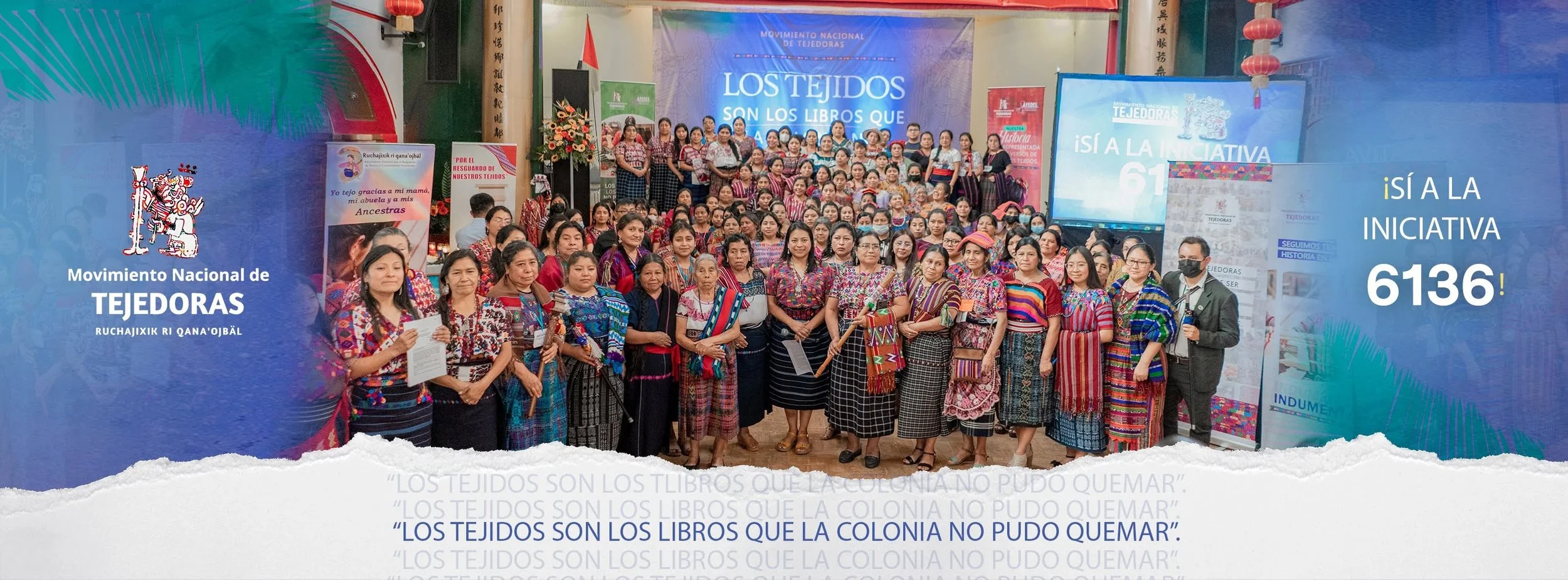
We have much to learn from this Movement, and all of us have much to gain from its strengthening.
Our communities, now working together under the banner of For A Loving Future, have been building a bridge of relationship to walk with the National Maya Weavers Movement. Together, we are giving shape to our shared vision of Movimientos Deslumbrantes and an emergent Rehumanizing Movement capable of centering life, protecting collective continuity, and building loving futures grounded in relationship, responsibility, beauty, creativity, and love.
The bridge we are building through For A Loving Future is intended to carry the exchange of knowledge alongside the movement of protection, resources, political recognition, responsibility, and friendship.
A bridge of relationship must be strong enough to carry protection as well as admiration.
We must walk this bridge when Maya culture is beautiful, inspiring, and compelling, and we must walk it when Maya authorities are incarcerated, when communities are managing danger, when leaders receive death threats, and when standing beside them requires us to make visible political choices.
Governor Aspuac’s visit to Worcester, Massachusetts, is another step across this bridge. It is an opportunity to recognize Indigenous nations as political peoples whose governance, discernment, and commitment to life carry essential knowledge for our collective future.
Democracy in Guatemala was protected by the very peoples the state had once tried to eliminate. Those peoples are now being asked to defend their authorities, territories, creations, and right to continue existing as peoples.
We cannot claim to honor Maya culture while helping to make Maya peoples disappear.
We have much to learn from the National Movement of Maya Weavers, and much to gain from its strengthening.
Join us in the work of building this bridge.
Women’s Leadership in the Defense of Democracy in Everyday Life will take place on July 30, from 10:00 a.m. to 1:00 p.m., at the Worcester State University Wellness Center, Room 204, in Worcester, Massachusetts. Lunch will be served from 12:00 to 1:00 p.m.
There is still space to participate. Because of security considerations, and so that we can prepare enough lunches, we ask that every person attending register in advance. Those within driving distance of Worcester can register here.
And in case you are in Boston or Framingham, we will be joining our community of the Center for Cooperative Development and Solidarity on the afternoon of 7/29 in Eastie, and Gems @ The Arts in Framingham on the late afternoon of 7/30. Please reach out if you would like to connect with us then.
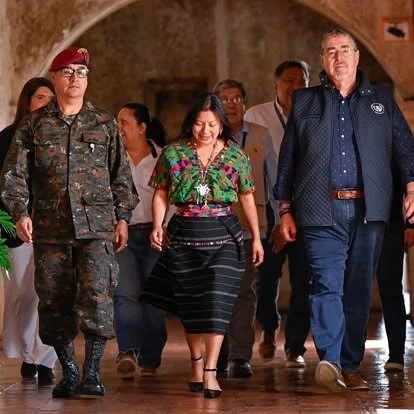
Governor Aspuac welcomes Guatemalan President Bernardo Arévalo to Sacatepéquez.
Get in touch